%20(1).png?width=600&height=338&name=menu_thumbnail%20(4)%20(1).png)
%201.svg)



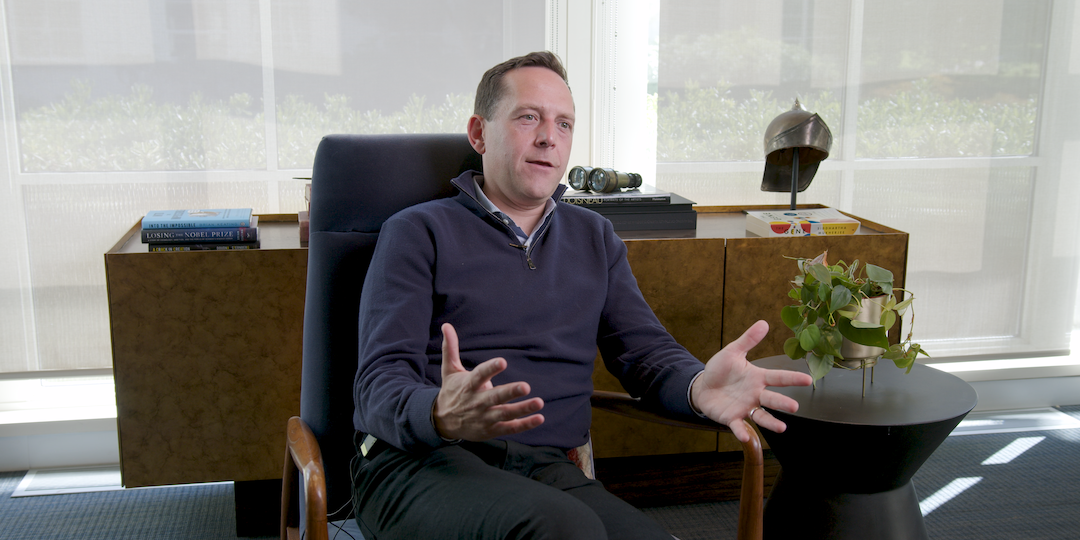
Erik Ragatz discusses the firm's focused approach to PE investment and selecting companies
Key Takeaways
- Erik Ragatz, partner at Hellman & Friedman, discusses the firm's multi-decade top quartile performance in private equity.
- They've built decades of relationships up with top management teams/industry leaders, providing them top deal flow and the ability to move quickly on these deals.
- They add value by being active partners with management, aligning incentives, and increasing operational efficiency.
Transcript
My name's Eric Ragatz. I'm a partner at a private equity firm in San Francisco called Hellman & Friedman. I was a consultant - Bain Capital was one of the few firms that was hiring. I was there for a couple of years, ended up going back to business school, brought me back to California. And then in 2001, I joined Hellman & Friedman.
Most of the private equity firms that are out there, frankly, probably all of them have the same basic structure. Where we fit in to that is we are at the larger end - so names like Blackstone and Carlyle and KKR are kind of the firms that we would typically associate ourselves with in terms of fund size. And those firms really have grown similarly over the course of the last 20 years, but have done really two things, which is, one, they've sold their own capital, so gone public, sold to another limited partner, done something to monetize the stake of the original founders. The other things they've done is really become a broad based financial institutions. What we've done is really kind of stayed true to our knitting, which is we stuck to being a very focused firm. We're just a private equity firm, so we haven't gone out and raised other funds. In fact, we've just got one global fund. Even within that global fund structure, we've really gotten just one very simple investment philosophy, and that's investing in just the highest quality businesses around. And it's kind of as simple as the motherhood and apple pie of businesses that are sustainably differentiated, produce real cash flow, have great management teams and grow. Ultimately, every investment stands on its own. And it's that focused approach that I really think differentiates us.
So I currently chair the board of a public company called Grocery Outlet. It's sort of a classic example of what we're trying to do at Hellman & Friedman. Grocery Outlet is effectively the TJ Maxx of grocery. So we source goods opportunistically - that means we go to the big CPG companies and buy impaired inventory, not things that are past date code, but for whatever reason, it's an innovation that didn't work or an overproduction. We buy at fifty cents on the wholesale dollar, sell them through our network of now four hundredish stores at twenty percent discount to Walmart and probably 60 percent discount to the Safeway. It's the conventional grocers of the world. We do that in a very different structure. So we have independent operators with whom we split gross margin fifty fifty. So they've got local autonomy and incentives and really build sort of this high service based culture. So we looked at that and spent a huge amount of time really trying to get our head around: What was the nature of the franchise? What was the nature of the competitive position, the moat and how much runway do we really have to continue to monetize that that moat? And, you know, ultimately where a lot of folks just said "grocery? not for me," we really dug in and took advantage of, you know, the fact that we've got information that wouldn't be available to a public company investor in a private context. [We] looked at the store cohorts, looked at all of their data on how the same store sales were performing on ticket versus traffic, really got to know the management teams and ultimately brought to bear a perspective that we thought we could continue to accelerate store based growth. That was going to really be the insight that ultimately allowed us to pay up. And so it affords us the ability to not wait and stay at our desks and get books in from investment banks, but to really go out and build relationships with management teams.
I think about my job as the chairman of these businesses is to create the conditions for our management teams to be most successful. And what does that mean? It means what we do is we partner with businesses and we spend all of our time trying to make these better businesses. And you know, that I think historically in the private equity world has meant cutting costs. That's not what it means in our world. We've got a very strong definition of what great looks like in a company. And that's in our perspective. That's a marketing perspective. That's a product in R&D perspective. And we hold our teams accountable to go deliver and great.
There are some different risks that we can help address. And we think that's a big part of our role prudently. We think generally we think a business can only handle so much risk. We think financial risk in this day and age actually is a good risk to take. For the right businesses, you covenants and a lot of these debts, and you can really, you know, bear some some volatility in the business, you've got to make sure that you're not getting business risk and operating risk and other risk happening. So for us, again, it comes back to that business quality point, putting almost all your risk into the financial world versus the business risk world. We're really just trying to pay out Krymsk in the world, if you will, for the best businesses.
Important disclosures
Opto Investment Management, LLC (the “Firm”) is a wholly-owned subsidiary of Opto Investments, Inc. and is an SEC-registered investment advisor. Registration with the SEC does not imply a certain level of skill or training. SEC registration does not mean the SEC has approved of the services of the investment adviser. This website is operated and maintained by Opto Investments, Inc. Certain products described herein and institutional relationships may involve investment advisory services provided by the Firm. This website is presented for financial institutions and investment professionals only and is not intended for individual consumers or retail investors, unless specifically noted. Unless otherwise indicated, commentary on this site reflects the personal opinions, viewpoints and analyses of the author and should not be regarded as a description of services provided by the Firm or its affiliates. The opinions expressed here are for general informational purposes only and are not intended to provide specific advice or recommendations for any individual on any security or advisory service. It is only intended to provide education about the financial industry. The views reflected in the commentary are subject to change at any time without notice. While all information presented, including from external, linked or independent sources, is believed to be reliable, we make no representation or warranty as to accuracy or completeness. We reserve the right to change any part of these materials without notice and assume no obligation to provide updates. Nothing on this site constitutes investment advice, performance data or a recommendation that any particular security, portfolio of securities, transaction or investment strategy is suitable for any specific person. We disclaim any responsibility for information, services or products found on linked websites. Images and photographs are included for the sole purpose of visually enhancing the website. None of them show current or former clients and should not be construed as an endorsement or testimonial. All investing is subject to risk, including loss of principal. Historical performance is not a guarantee of future performance and clients may experience different results. This information contains certain “forward-looking statements,” which may be identified by the use of such words as “believe,” “expect,” “anticipate,” “should,” “planned,” “estimated,” “potential” and other similar terms. Examples of forward-looking statements include, but are not limited to, estimates with respect to financial condition, results of operations, and success or lack of success of the depicted investment strategy. All are subject to various factors, including, but not limited to general and local economic conditions, changing levels of competition within certain industries and markets, changes in interest rates, changes in legislation or regulation, and other economic, competitive, governmental, regulatory and technological factors affecting operations that could cause actual results to differ materially from projected results. See related disclosures at https://www.optoinvest.com/disclaimers.