%20(1).png?width=600&height=338&name=menu_thumbnail%20(4)%20(1).png)
%201.svg)


.jpg?width=45&name=Insights_Dave_Friedberg%20(1).jpg)
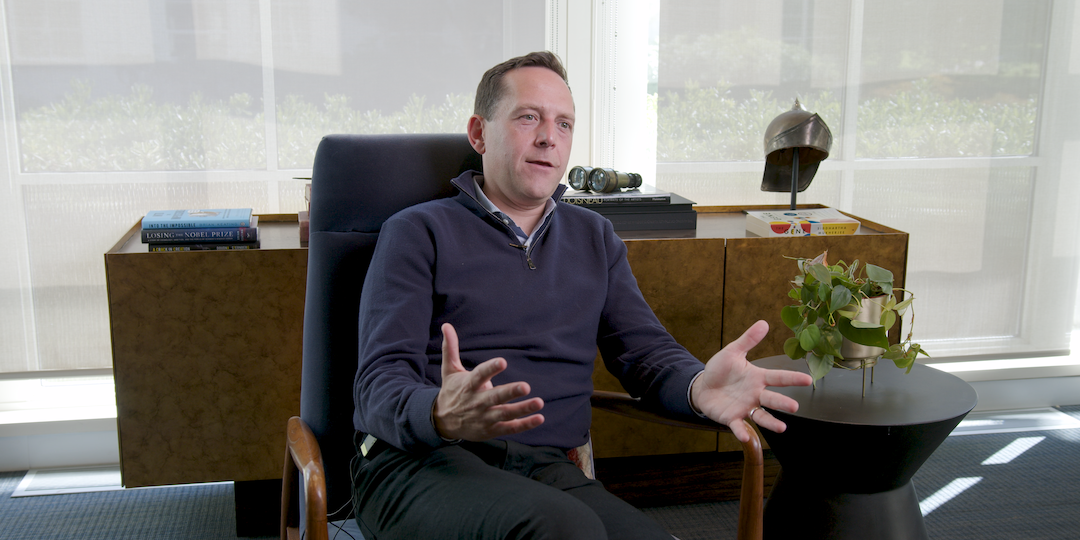
The TPB founder explains the value of contrarian investing and risk, and three startup success predictors
Key Takeaways
- Dave Friedberg of The Production Board explains the importance of smartly investing against the market consensus. By identifying areas where the market may be mispricing assets, investors may be able to achieve better outcomes.
- Without risk, there is no alpha in an investment. But risk needs to be relatively manageable. If the risk can be reduced and there are enough technical advantages in a business, the probability of success and market disruption improve greatly.
- Dave identifies three key predictors of startup success: narrative, grit, and a bias to action.
Transcript
I'm Dave Friedberg. I'm the founder and CEO of the Production Board.
If you invest with the market, meaning everyone is saying something is absolutely going to happen this way. You're going to get market-matching returns. If you invest where the market isn't, either you're before the market, or you disagree with the market. So the market says something is 100% likely to happen, and you think there's a non-zero chance that doesn't happen. And if I'm right, I'm going to get paid off. That's the sort of investments we should be making if we want to get market-beating returns. Or if the market's saying there's no way something is going to happen, and I think there's a non-zero chance that does happen. And if it does, I'm going to get paid off. That's the sort of bet I should be making. We need to see behavior like that from investors, from managers, which is show me where you aren't following the market, where you disagreed, where you didn't just do what the market is doing, and ultimately index meat in the market. I think that that's a fairly important point.
If we don't take risk, there's no alpha, okay? So there has to be some uncertainty and some uncertainty in the paths that the business might take to commercialize or uncertainty in terms of the product that they're going to make, how they're going to get there, if there's too many steps of uncertainty, those error bars compound and they can destroy the unit economics and the business can't actually find a path to profitability over time. So part of our objective is really to make sure that we understand all the steps needed to ultimately generate what assumed unit economics on the business and how many of those steps are still risky. And if there are too many uncertainties in those steps, then it's not an investment for us. But if we can narrow the uncertainty that, we start to feel like there's such a technical advantage in this business that even with those bars of uncertainty, there's just a very high probability or decent probability that we will be able to get positive unit economics and disrupt the market. That's where we get very comfortable.
So we actually build very deep models. Every time we make an investment in the synthetic biology market space, we have very large techno-economic analytics models where we try and identify all the steps that are needed to deliver an outcome in the business. What are the risks? What are the uncertainties, and what are the known knowns and the known unknowns? And from there, we can kind of build an assessment of how likely is it to have a ten x, 100 X, etc., in our investment from here forward. So that's a big part to really try and get analytical about it. We're also trying to avoid investor capital risk, meaning we want to make sure that we're not betting on the market being there for a business, that there are several paths to accessing capital through partnerships, through commercial deals, through customers, through grants. And so, you know, we're increasingly trying to identify opportunities that are less dependent on the typical kind of investor cycling investor funding cycle in life sciences.
And then I would say, you know, for us, I think that there's three big predictors of success in a startup. One of the key kind of predictors of success in early-stage startups, from our point of view, is narrative, the power of narrative. I think you can index from zero to infinity on the power of your narrative. That's something we look for in every entrepreneur, and every founder is how do they index on that narrative? Every index on infinity, they index very high. They're going to make up for a lot of other problems and a lot of other mistakes and errors and issues.
The second is grit. And grit is really the power of persistence. The ability to push through failure. Building a startup is predominantly failure, and most people who have had a life of success are generally not very good at managing failure because they haven't had to. So if you look at someone who graduated from a great high school, went to a great college, worked at a great big company afterwards, and then they try and start a company, they're more likely than not going to quit when they start to hit several bouts of failure. If you look at someone who's an immigrant, someone who came from nothing, someone who has a chip on their shoulder, when they build a business, they don't give up. There is no option for failure. And so, the setbacks that arise, they're able to persist through and succeed. And I think that someone with that mentality or that index is high on this index of grit, that person is far more likely to succeed than someone who may be smarter than them or who have more connections or what have you. Because a company that's led by the right founder with no capital will still find a way to get people to work for free and will still work for free themselves.
And then the third is bias to action, which is how quickly does the leadership learn from what the market is telling them, the customers are telling them, and iterate their business. You can learn this from someone when you talk to them about how they think about their business. They're not thinking about one deterministic path. They're thinking about all the paths they could walk. And then they talk about what the market is telling them and how they're now choosing this path, and what they're going to learn from the market next to decide the next path. And the pace at which one makes decisions, I think, is a much greater predictor of success than the accuracy of the decisions that the CEO makes.
So those are three things that we think significantly increase our likelihood of success with our investments, reduce the risk that we're taking is to find entrepreneurs, to find founders that index high on at least one, but ideally several of those three indices.
Important disclosures
Opto Investment Management, LLC (the “Firm”) is a wholly-owned subsidiary of Opto Investments, Inc. and is an SEC-registered investment advisor. Registration with the SEC does not imply a certain level of skill or training. SEC registration does not mean the SEC has approved of the services of the investment adviser. This website is operated and maintained by Opto Investments, Inc. Certain products described herein and institutional relationships may involve investment advisory services provided by the Firm. This website is presented for financial institutions and investment professionals only and is not intended for individual consumers or retail investors, unless specifically noted. Unless otherwise indicated, commentary on this site reflects the personal opinions, viewpoints and analyses of the author and should not be regarded as a description of services provided by the Firm or its affiliates. The opinions expressed here are for general informational purposes only and are not intended to provide specific advice or recommendations for any individual on any security or advisory service. It is only intended to provide education about the financial industry. The views reflected in the commentary are subject to change at any time without notice. While all information presented, including from external, linked or independent sources, is believed to be reliable, we make no representation or warranty as to accuracy or completeness. We reserve the right to change any part of these materials without notice and assume no obligation to provide updates. Nothing on this site constitutes investment advice, performance data or a recommendation that any particular security, portfolio of securities, transaction or investment strategy is suitable for any specific person. We disclaim any responsibility for information, services or products found on linked websites. Images and photographs are included for the sole purpose of visually enhancing the website. None of them show current or former clients and should not be construed as an endorsement or testimonial. All investing is subject to risk, including loss of principal. Historical performance is not a guarantee of future performance and clients may experience different results. This information contains certain “forward-looking statements,” which may be identified by the use of such words as “believe,” “expect,” “anticipate,” “should,” “planned,” “estimated,” “potential” and other similar terms. Examples of forward-looking statements include, but are not limited to, estimates with respect to financial condition, results of operations, and success or lack of success of the depicted investment strategy. All are subject to various factors, including, but not limited to general and local economic conditions, changing levels of competition within certain industries and markets, changes in interest rates, changes in legislation or regulation, and other economic, competitive, governmental, regulatory and technological factors affecting operations that could cause actual results to differ materially from projected results. See related disclosures at https://www.optoinvest.com/disclaimers.