%20(1).png?width=600&height=338&name=menu_thumbnail%20(4)%20(1).png)
%201.svg)


How MSD Partners has built a portfolio to provide downside protection and long term returns
Key Takeaways
- Family offices have a distinct set of considerations when making investments - Long investment horizons and liquidity agnosticism are among the most important.
- Their investment philosophy is "protect capital". That means, figuring out how to structure downside protection and then grow returns over a long horizon.
- Private Credit provides current income and downside protection, real estate has great tax benefits and long horizons and private growth equity can drive significant capital appreciation.
- Their portfolio is allocating more and more to private market managers, while simultaneously some private allocations like hedge funds are being moved into liquid counterparts like low-expense ETFs.
Transcript
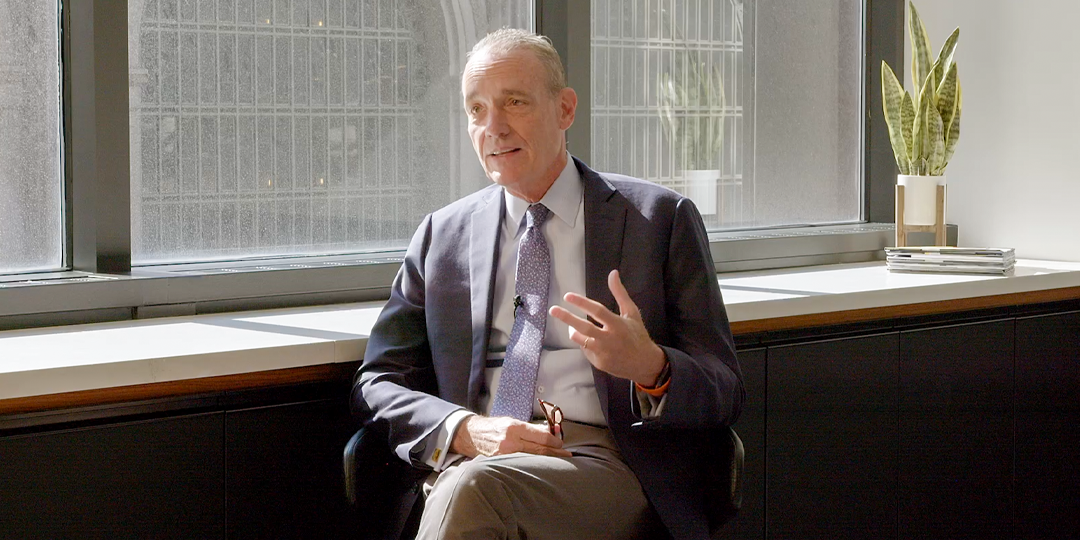
My name is Gregg Lemkau, I'm CEO of MSD Partners. I joined the firm about a year ago after spending 28 years at Goldman Sachs, where my last job was the head of global investment banking. MSD Partners is really two things, there's MSD Capital and MSD Partners. MSD Capital was started in 1998 really as the family office of the Dell Family. In 2009 we started MSD Partners, which is a registered investment advisor that allows us to take third-party capital. So today we've actually got MSD Capital, MSD Partners. In aggregate we manage about 23 plus billion dollars of capital 16 or 17 for the Dell family, and the rest of it being employees and partners of the firm and outside investors. And we try to do so across four asset classes for places where we feel like we've got real differentiation. We've got a private capital business, credit business, a real estate business, and a growth equity business.
My personal investment philosophy is very much shaped from where I am right now, which is driving great risk-adjusted return. Right before I started the job, I went for a long walk with Michael and talked about objectives. Are you focused on multiple money? Are you focused on IRR? Are you focused on driving the franchise value at MSD Partners? He kind of thought about it and he said, you know, all of those sound like good things, but let's be very clear, there's like, get rich and stay rich. Right. He goes like, I already got the get rich part, so I'm focused on staying rich. And so I was like, note to self don't lose Michael Dell's money.
I think that informs my investment philosophy, which is, you know, protect capital. Figure out how to structure downside protection and then grow compounded returns over a long period of time, we have the flexibility of being able to look through cycles over the long term.
If you look at the portfolio where we're actively driving strategies, our direct investing business, I kind of think of the spectrum of credit on one end, which is, you know, structurally protected downside protected 9 to 13% returns, but really steady, safe, good returns. As Michael said, I'll put all my money in there and just leave it there forever. You then got real estate again, which is kind of a different asset class, has great tax attributes for individual investors, can hold it for the long term. And we own a bunch of really interesting assets. You know, we own the Four Seasons in Maui, we own the Four Seasons on the big island of Hawaii, and, you know, properties, you know, we're going to have value for a long period of time. And then we've got a private capital business again where you can use leverage, you can buy companies, you can hold them for a longer period of time. There's a little bit more beta inside that investment strategy. And then in the past year, we just built out a growth equity strategy, which we actually really hadn't had before. But another way to try to drive some upside return again, bigger, bigger beta inside that portfolio.
But, you know, one of the things I observed when I first got to MSD is we really didn't have a growth equity business, which struck me as a little bit crazy because it's Michael Dell's family office. And I think the mindset for a long time had been, you know, go back to 1998. It was diversify away from technology and from growth and which were PCs and never really picked anyone's heads up to say there's a lot more to growth in PCs and virtualization software. And we've got this iconic founder at the top of the firm who is a mentor to a whole bunch of entrepreneurs and being able to use his position in the world and the access and network that he has to be able to source late-stage growth equity investments has been a real differentiator for us.
And so what I've tried to tell our team is there's a lot of capital out there in the world looking to invest in deals, and we should try to be investing where we're really differentiating. So, the transition away from liquid assets happened a little bit, started before I got there, and has continued to transition over time. And part of it is trying to find places, like I said, where we have an edge. And I think in a direct investment, we've got a real edge in that advantage. And candidly, if you look back on some of the public equity investing over a long period of time, you know, the S&P has probably outperformed, you know, every individual hedge fund that's out there. And so do you want to go pay 2 and 20 a bunch of managers, or do you want to go put a bunch of capital, the S&P at a much lower fee rate? You know, that has tended to be a good trade for a long period of time, and I think as a firm we saw that and thought we could put a lot of our public liquid strategies in something more like an ETF or an index. We could hedge around that as we needed to protect it for upside and downside risks and then deploy more capital more actively on the direct side where we thought we had some kind of advantage relative to the market.
Important disclosures
Opto Investment Management, LLC (the “Firm”) is a wholly-owned subsidiary of Opto Investments, Inc. and is an SEC-registered investment advisor. Registration with the SEC does not imply a certain level of skill or training. SEC registration does not mean the SEC has approved of the services of the investment adviser. This website is operated and maintained by Opto Investments, Inc. Certain products described herein and institutional relationships may involve investment advisory services provided by the Firm. This website is presented for financial institutions and investment professionals only and is not intended for individual consumers or retail investors, unless specifically noted. Unless otherwise indicated, commentary on this site reflects the personal opinions, viewpoints and analyses of the author and should not be regarded as a description of services provided by the Firm or its affiliates. The opinions expressed here are for general informational purposes only and are not intended to provide specific advice or recommendations for any individual on any security or advisory service. It is only intended to provide education about the financial industry. The views reflected in the commentary are subject to change at any time without notice. While all information presented, including from external, linked or independent sources, is believed to be reliable, we make no representation or warranty as to accuracy or completeness. We reserve the right to change any part of these materials without notice and assume no obligation to provide updates. Nothing on this site constitutes investment advice, performance data or a recommendation that any particular security, portfolio of securities, transaction or investment strategy is suitable for any specific person. We disclaim any responsibility for information, services or products found on linked websites. Images and photographs are included for the sole purpose of visually enhancing the website. None of them show current or former clients and should not be construed as an endorsement or testimonial. All investing is subject to risk, including loss of principal. Historical performance is not a guarantee of future performance and clients may experience different results. This information contains certain “forward-looking statements,” which may be identified by the use of such words as “believe,” “expect,” “anticipate,” “should,” “planned,” “estimated,” “potential” and other similar terms. Examples of forward-looking statements include, but are not limited to, estimates with respect to financial condition, results of operations, and success or lack of success of the depicted investment strategy. All are subject to various factors, including, but not limited to general and local economic conditions, changing levels of competition within certain industries and markets, changes in interest rates, changes in legislation or regulation, and other economic, competitive, governmental, regulatory and technological factors affecting operations that could cause actual results to differ materially from projected results. See related disclosures at https://www.optoinvest.com/disclaimers.