%20(1).png?width=600&height=338&name=menu_thumbnail%20(4)%20(1).png)
%201.svg)


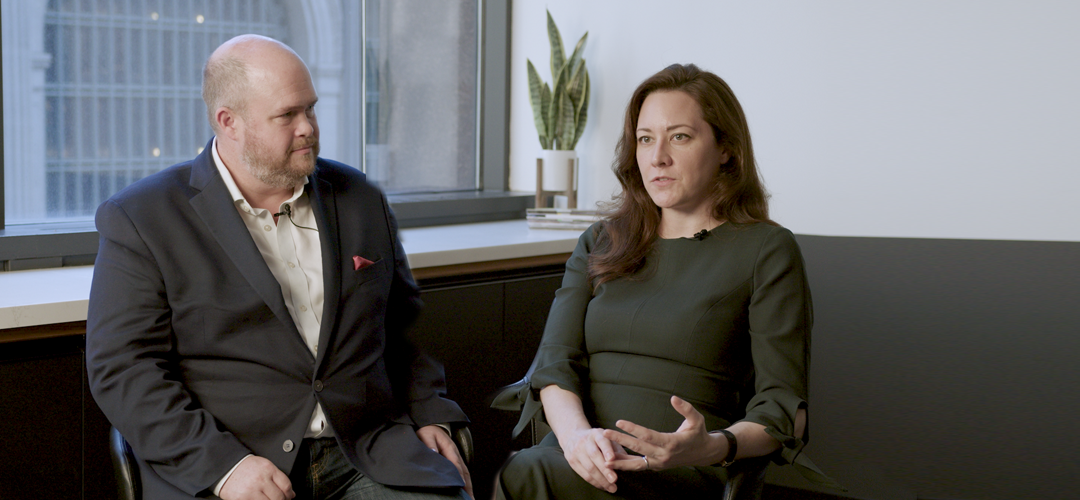
The partners at Audere Capital discuss what can make and/or break the investor/founder relationship
Key Takeaways
- Founders need to be resilient, gritty, and readily adaptable to changing market conditions.
- Before writing a check, many venture capitalists want to understand what - beyond money - motivates a founder to succeed - such as a personal mission or opportunity.
- Not all investors are created equal, and the best founder/investor relationships are based on collaboration and strategically aligned interests.
Transcript
Peter Ackerson I am Peter Ackerson, and I'm a general partner at Audere Capital.
Maggie Sprenger Hi, I'm Maggie Sprenger. I'm a general partner at Audere Capital.
Peter Ackerson Audere Capital is an early-stage venture company focused on investing in five areas of critical technology that are on the cusp of what we think will be a significant, multi-decade-long run of impact.
Maggie Sprenger We invest in early-stage technology companies focused on the intersection of national security and priority, deep tech, and VC, of course.
When we're looking at start-ups, of course, we're taking into consideration things like the TAM and the technologies. But part of the joy of working with early-stage companies is working very closely with founders. We definitely like to look for a founder who is going to be resilient and gritty. One of the things that I definitely know about founding an early-stage company is that invariably you're going to have to pivot, iterate, or come up with a totally different idea based on, you know, changing market conditions or something disruptive that's happened within the technology.
There's a great line from Josh Wolfe, who's founder at Lux Capital, and he says he looks for founders with chips on their shoulders because that means chips in pockets, and it always makes me laugh because I think it's really true. I think the founders that are driven by something so much greater than making money are the founders that succeed. Anyone can go start a company. It's a hard thing to do, but if you're just doing it for financial return, you're missing out on the major driver. So whether it's a mission or a motivator, whether it's an opportunity to prove yourself to people, these are the things that we want to get to the bottom of before we write that check.
Peter Ackerson I make a joke all the time that venture, in some ways, is sort of like Hollywood for less attractive people. Creative industries always work this way, right? You have collaboration, and you don't often know who's shady or who's unreliable or who's going to do things that you don't like until you're like two-thirds of the way through. Which is why for those who can survive the last five, ten, fifteen years, there's a huge advantage because you eventually find your people and the people that you know to avoid. I’ve been in moments where you have founders who just didn't know, right? And so they didn't raise capital from the right people and that doesn't even necessarily mean they raised capital and have on the board bad investors. Sometimes it simply means that they have very passive investors and they thought money is money and then they needed more support and they just couldn't get it. Other times, you know, they end up pivoting the business in some new direction, and they had a group of investors who were super useful in one context. And through no fault of anybody's, they’re no longer a fit for the investment strategy of their earlier investors. And that happens. And, you know, that's when you work through those issues.
Important disclosures
Opto Investment Management, LLC (the “Firm”) is a wholly-owned subsidiary of Opto Investments, Inc. and is an SEC-registered investment advisor. Registration with the SEC does not imply a certain level of skill or training. SEC registration does not mean the SEC has approved of the services of the investment adviser. This website is operated and maintained by Opto Investments, Inc. Certain products described herein and institutional relationships may involve investment advisory services provided by the Firm. This website is presented for financial institutions and investment professionals only and is not intended for individual consumers or retail investors, unless specifically noted. Unless otherwise indicated, commentary on this site reflects the personal opinions, viewpoints and analyses of the author and should not be regarded as a description of services provided by the Firm or its affiliates. The opinions expressed here are for general informational purposes only and are not intended to provide specific advice or recommendations for any individual on any security or advisory service. It is only intended to provide education about the financial industry. The views reflected in the commentary are subject to change at any time without notice. While all information presented, including from external, linked or independent sources, is believed to be reliable, we make no representation or warranty as to accuracy or completeness. We reserve the right to change any part of these materials without notice and assume no obligation to provide updates. Nothing on this site constitutes investment advice, performance data or a recommendation that any particular security, portfolio of securities, transaction or investment strategy is suitable for any specific person. We disclaim any responsibility for information, services or products found on linked websites. Images and photographs are included for the sole purpose of visually enhancing the website. None of them show current or former clients and should not be construed as an endorsement or testimonial. All investing is subject to risk, including loss of principal. Historical performance is not a guarantee of future performance and clients may experience different results. This information contains certain “forward-looking statements,” which may be identified by the use of such words as “believe,” “expect,” “anticipate,” “should,” “planned,” “estimated,” “potential” and other similar terms. Examples of forward-looking statements include, but are not limited to, estimates with respect to financial condition, results of operations, and success or lack of success of the depicted investment strategy. All are subject to various factors, including, but not limited to general and local economic conditions, changing levels of competition within certain industries and markets, changes in interest rates, changes in legislation or regulation, and other economic, competitive, governmental, regulatory and technological factors affecting operations that could cause actual results to differ materially from projected results. See related disclosures at https://www.optoinvest.com/disclaimers.