%20(1).png?width=600&height=338&name=menu_thumbnail%20(4)%20(1).png)
%201.svg)


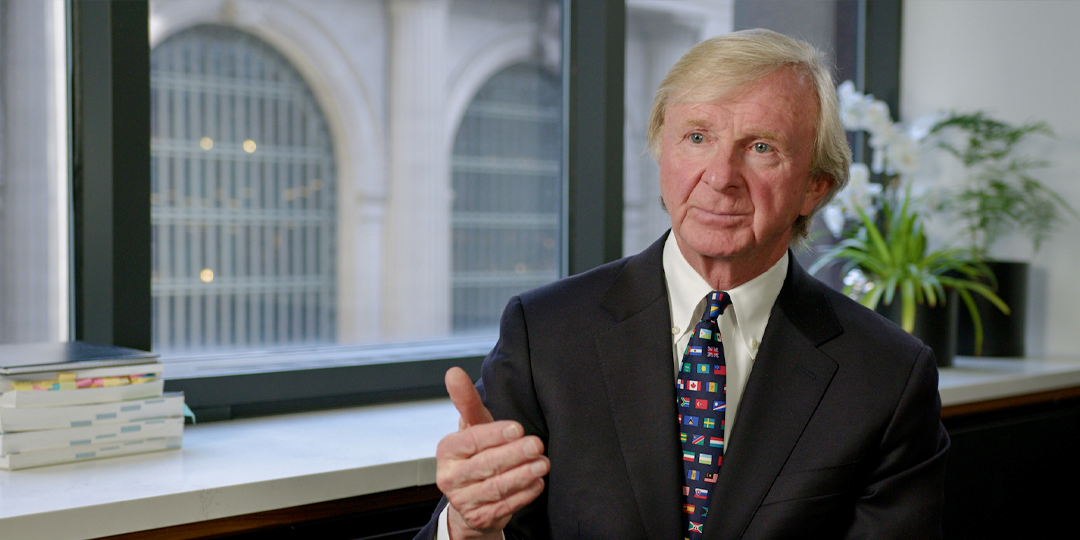
Financial services can be diversifying during times of economic uncertainty.
Key Takeaways
- Chuck Davis, CEO and Co-Founder of financial services private equity firm Stone Point Capital, discusses the breadth of sectors in financial services.
- There are many sectors within financial services which can actually benefit from rising rates/a slowdown in growth.
- One example is servicing firms for bankruptcies, which naturally see profits increase at a time when other companies hurt.
- Many of these subsectors are uncorrelated to each other, meaning financial services can be an attractive sector to invest in when most others are not or can be diversifying to existing allocations.
Transcript
I'm Chuck Davis. I'm the CEO of Stone Point Capital. I spent 20 years as a partner at Goldman Sachs. And then, 20 years ago started, Stone Point with four partners, and we are a private equity firm focusing on financial services.
Financial services is a very large, very complex set of companies and industries, and it goes the gamut from banking and insurance and credit, and it's heavily regulated. And the balance sheet risk that you take in that sector can be quite significant. Our focus is much more on the free cash flow service businesses who provide products and services to the big balance sheet financial institutions. So a JPMorgan or a Chubb or a Traveler's or a Bank of America, Merrill Lynch, we would own several companies that would have a fee-paying assignment with them, providing software, providing distribution, providing claims, adjusting, adjudicating. There's all kinds of these wonderful little businesses that are involved in serving the financial services sector.
The great thing is many of these sectors are not correlated to each other. If you invest in an energy fund and oil goes from 20 to 100, you're going to do well. If oil goes from 100 to 20, it's almost impossible to get out of the way. But we have all these countervailing forces going on in insurance, in credit, in the economy, in interest rates. We are always finding places where there's excess demand for products and services. Rising rates are a good thing for companies who have float, who have money that they sit on behalf of their customers. And we own a number of companies that take in money and hold it for a long period of time. And when interest rates go up, they make a lot more money. Obviously, higher rates generally will slow down the economy and cause some things to not be good, and maybe we head into a recession. So there definitely are companies that do not do well when rates go up. If you use excessive leverage and rates are going up, you're the cost of your debt is going to be higher. So you have to be careful of that.
But what's going on right now is a natural transition. It took longer than we would have thought from the global financial crisis more than ten years ago until today, where the Fed has been lowering rates basically for over a decade, and now they're raising rates. A very wise person once said, don't fight the Fed. You really got to be careful when the Fed's on your side like they have been the last ten years. It's been relatively easy now that rates are going the other way. You really have to be careful where you put your money. And we've been focused on that for a number of years. We've lived through this cycle before in our prior lives. And we think we can take advantage of that by the types of companies we invest in. And we have a lot of companies that will do well and do better that are countercyclical that will do better in a soft economy or in a recession or in a rising rate environment than they would do in a benign environment.
The financial services sector is the biggest in the economy. It's about 25% of the GDP. So there's plenty to do there, and there's a lot of uncorrelated things going on inside of financial services.
Important disclosures
Opto Investment Management, LLC (the “Firm”) is a wholly-owned subsidiary of Opto Investments, Inc. and is an SEC-registered investment advisor. Registration with the SEC does not imply a certain level of skill or training. SEC registration does not mean the SEC has approved of the services of the investment adviser. This website is operated and maintained by Opto Investments, Inc. Certain products described herein and institutional relationships may involve investment advisory services provided by the Firm. This website is presented for financial institutions and investment professionals only and is not intended for individual consumers or retail investors, unless specifically noted. Unless otherwise indicated, commentary on this site reflects the personal opinions, viewpoints and analyses of the author and should not be regarded as a description of services provided by the Firm or its affiliates. The opinions expressed here are for general informational purposes only and are not intended to provide specific advice or recommendations for any individual on any security or advisory service. It is only intended to provide education about the financial industry. The views reflected in the commentary are subject to change at any time without notice. While all information presented, including from external, linked or independent sources, is believed to be reliable, we make no representation or warranty as to accuracy or completeness. We reserve the right to change any part of these materials without notice and assume no obligation to provide updates. Nothing on this site constitutes investment advice, performance data or a recommendation that any particular security, portfolio of securities, transaction or investment strategy is suitable for any specific person. We disclaim any responsibility for information, services or products found on linked websites. Images and photographs are included for the sole purpose of visually enhancing the website. None of them show current or former clients and should not be construed as an endorsement or testimonial. All investing is subject to risk, including loss of principal. Historical performance is not a guarantee of future performance and clients may experience different results. This information contains certain “forward-looking statements,” which may be identified by the use of such words as “believe,” “expect,” “anticipate,” “should,” “planned,” “estimated,” “potential” and other similar terms. Examples of forward-looking statements include, but are not limited to, estimates with respect to financial condition, results of operations, and success or lack of success of the depicted investment strategy. All are subject to various factors, including, but not limited to general and local economic conditions, changing levels of competition within certain industries and markets, changes in interest rates, changes in legislation or regulation, and other economic, competitive, governmental, regulatory and technological factors affecting operations that could cause actual results to differ materially from projected results. See related disclosures at https://www.optoinvest.com/disclaimers.