%20(1).png?width=600&height=338&name=menu_thumbnail%20(4)%20(1).png)
%201.svg)


Tishman Speyer’s vertically integrated business model and the advantages of an extensive global presence
Key Takeaways
- Tishman Speyer is a global real estate company, investing in a diversified range of property and investment types.
- The firm operates with a vertically integrated model, including in-house capabilities across investing, developing, operating, financing, leasing, and management.
- They look for real estate projects in which they can create something innovative, or bring something new into existence.
- The company has a global presence, which generates significant advantages by allowing them to borrow best practices from various geographies around the world and drive innovation in the US by integrating them into their domestic projects.
Transcript
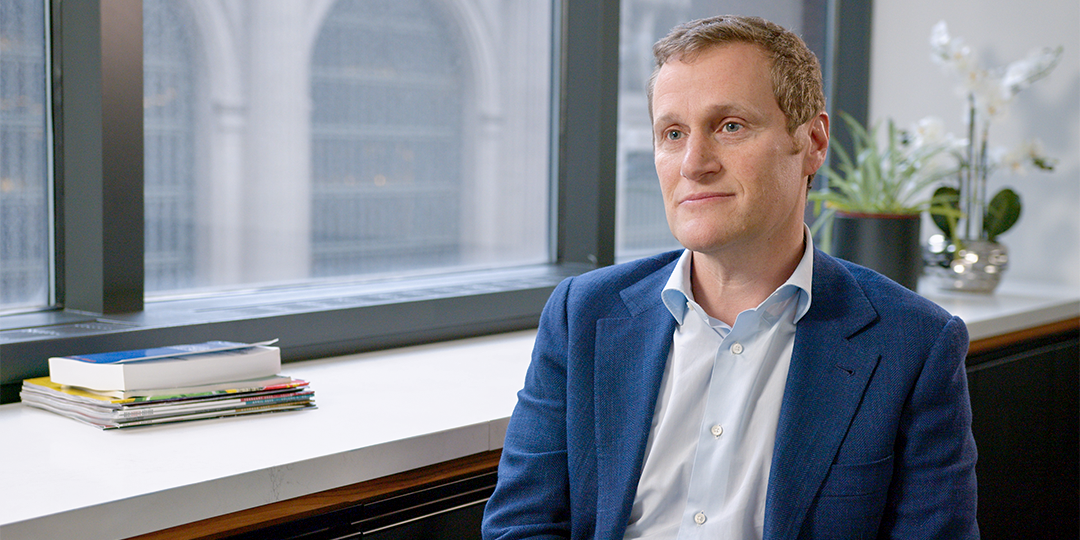
Hi, I'm Rob Speyer. I'm CEO of Tishman Speyer. We're a global real estate company headquartered here in New York City at Rockefeller Center, but with global operations across Asia, Europe, Latin America, and the United States. We invest in real estate ranging from office buildings to labs to residential to proptech to industrial buildings. So we are a fully diversified real estate company. We do value add and opportunistic. We also do core investing in income-producing properties. And then finally, sometimes we will develop the core, meaning we will do ground-up development of a building, and then we will hold it long term for the income profile. We have a vertically integrated model, everything that adds value to real estate we do in-house. So we're not just capital allocators, we're doing the investing, but we're also doing the developing, the operating, the finance, the leasing, the management, all of that we have in-house. Our biggest edge is our people. We tend to have people that we train coming right out of school. So we acculturate them, and we give them all the real estate skills. And my job is basically to empower them, define real estate, where we can differentiate it, where we can create something that doesn't exist, where we can buy a building and reinvent it, where we can buy a piece of land and create a neighborhood. So it's kind of seeing things that don't exist yet and then bringing them into existence. Twenty years ago, an entrepreneur named Bill Model, who is famous for creating the model sporting goods empire, he bought up a whole swath of Long Island City, which is a neighborhood in Queens. And at the time, the area that he bought was completely desolate. In fact, it only had one purpose. It was where the Rikers Island jail let out the inmates every week. So this was not an obvious place to do real estate development. But Bill took me on a walk, and suddenly we were in a pretty nice neighborhood with single-family homes, with an office building that was occupied by Citigroup. And I thought to myself, wait a second, we could carry this over to Bill's land, and we could create something special. And now, 20 years later, it's got two-thousand apartments that we've developed. It's got four and a half million feet of commercial space. It's got three acres of parks, and it's a neighborhood, and it's a place that people choose to live and choose to eat and choose to work. And we created it literally out of nothing. Until about ten years ago, we were best known for investing in and developing office buildings, and then we started towards a big diversification push, and we moved into residential, into a big way and then into life sciences and then into venture investing, into proptech and now into industrial. And we've always been quite geographically diverse. So we were the first US developer to go to Europe and then to Latin America, and more recently, to Asia.
So as an example, in Europe, 25 years ago, we started learning about sustainability and the importance of climate change and the role that real estate had, both in carbon emissions, but also in terms of being part of the solution, and we brought that practice to the US, to Latin America, and to Asia. Another example it was in Asia, that we learned about mixed-use development, about combining offices apartments, hotels, retail, all in one building or in one district of buildings. And so now I look at some of the exciting projects we're doing here in the US are joint ventures with Harvard, with the San Francisco Giants, with the San Diego Padres, with Carnegie Mellon University. And we're taking all the mixed-use practices that we learned in Asia, and we're bringing them here to innovate in the United States. And that's one of the great benefits of being global. I think of diversification in two ways. One is geographic, and the other is asset class. And I don't think you can achieve true diversification without both. So if you're in the United States, you want to get a piece of real estate in Europe, in Asia, and you want to also make sure you're not overly leveraged to one asset class. And again, real estate is such a large asset class that there are plenty of investable opportunities. You just have to find the right managers, people that you trust, and people that have good performance over a long period of time.
Important disclosures
Opto Investment Management, LLC (the “Firm”) is a wholly-owned subsidiary of Opto Investments, Inc. and is an SEC-registered investment advisor. Registration with the SEC does not imply a certain level of skill or training. SEC registration does not mean the SEC has approved of the services of the investment adviser. This website is operated and maintained by Opto Investments, Inc. Certain products described herein and institutional relationships may involve investment advisory services provided by the Firm. This website is presented for financial institutions and investment professionals only and is not intended for individual consumers or retail investors, unless specifically noted. Unless otherwise indicated, commentary on this site reflects the personal opinions, viewpoints and analyses of the author and should not be regarded as a description of services provided by the Firm or its affiliates. The opinions expressed here are for general informational purposes only and are not intended to provide specific advice or recommendations for any individual on any security or advisory service. It is only intended to provide education about the financial industry. The views reflected in the commentary are subject to change at any time without notice. While all information presented, including from external, linked or independent sources, is believed to be reliable, we make no representation or warranty as to accuracy or completeness. We reserve the right to change any part of these materials without notice and assume no obligation to provide updates. Nothing on this site constitutes investment advice, performance data or a recommendation that any particular security, portfolio of securities, transaction or investment strategy is suitable for any specific person. We disclaim any responsibility for information, services or products found on linked websites. Images and photographs are included for the sole purpose of visually enhancing the website. None of them show current or former clients and should not be construed as an endorsement or testimonial. All investing is subject to risk, including loss of principal. Historical performance is not a guarantee of future performance and clients may experience different results. This information contains certain “forward-looking statements,” which may be identified by the use of such words as “believe,” “expect,” “anticipate,” “should,” “planned,” “estimated,” “potential” and other similar terms. Examples of forward-looking statements include, but are not limited to, estimates with respect to financial condition, results of operations, and success or lack of success of the depicted investment strategy. All are subject to various factors, including, but not limited to general and local economic conditions, changing levels of competition within certain industries and markets, changes in interest rates, changes in legislation or regulation, and other economic, competitive, governmental, regulatory and technological factors affecting operations that could cause actual results to differ materially from projected results. See related disclosures at https://www.optoinvest.com/disclaimers.