%20(1).png?width=600&height=338&name=menu_thumbnail%20(4)%20(1).png)
%201.svg)


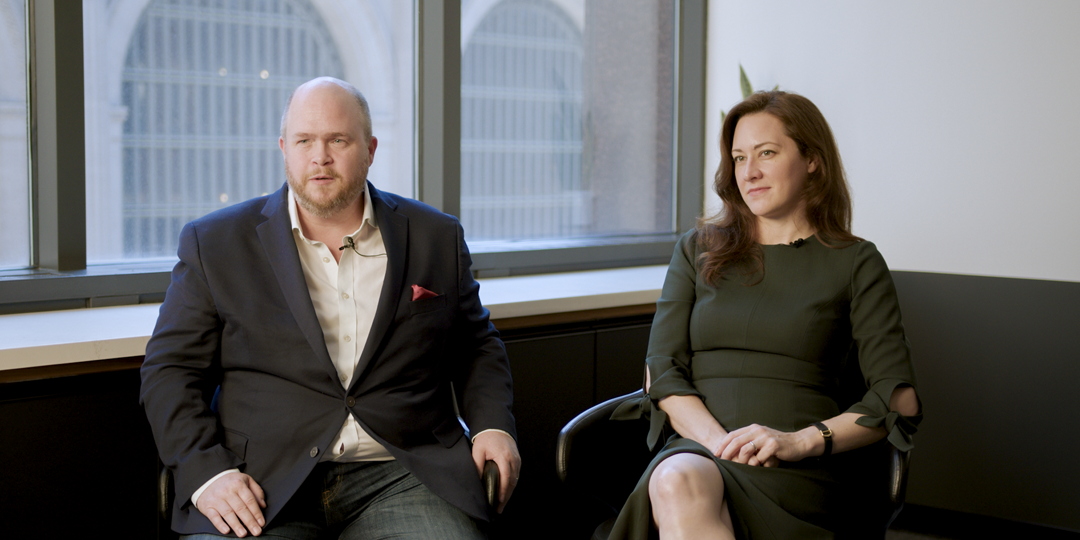
Maggie Sprenger and Peter Ackerson go into depth on a range of areas ripe for technological disruption
Key Takeaways
- Foundational tech often reshapes and solves problems in unexpected ways. It's not typically just a replacement; it can be a real revolution.
- To invest wisely, understanding tech's specific use cases and evolving value is crucial - beyond just enhancing experiences, it's about long-term business value.
- Certain emerging areas - like advanced communications, robotics (space, maritime), cybersecurity, and advanced manufacturing - are creating entirely new industries and possibilities.
Transcript
Peter Ackerson I am Peter Ackerson, and I'm a general partner at Audere Capital.
Maggie Sprenger Hi, I'm Maggie Sprenger. I'm a general partner at Audere Capital.
Peter Ackerson Audere Capital is an early-stage venture company focused on investing in five areas of critical technology that are on the cusp of what we think will be a significant multi-decade long run of impact.
Maggie Sprenger We invest into early-stage technology companies focused on the intersection of national security and priority, deep tech and VC, of course. Peter Ackerson One of the things about foundational technologies is that they don't typically represent what they replace. There's the adage that they don't typically represent what they replace. So, you can think of the automobile replacing the horse, or electricity replacing the kerosene lamp. They serve the same use case but from a very different vantage point.
You can look at the use cases and say that they will be solved, or you can understand that problem case. But the method of solution is often completely novel and unexpected. I think that's one of the exciting things about what we're going to see writ large in the innovation economy over the next decade or two. Things that were previously assumed to be preconditions of reality that are impossible and will never change will suddenly become solved in some very unique ways.
There are a number of areas of technology right now that are really on the cusp of having breakout moments, in our view. Candidly, a lot of these have been recognized by authorities ranging from corporate leadership in the US and globally, as well as governments. Looking at artificial intelligence, which is one of these critical technologies, it is going to change substantially every sector of the economy at some point in the next decade.
A.I., I think, properly conceived, needs to be thought of as more than simply an algorithm or a learning model, or a neural net. It really is the combination of the ability to, through new types of sensors, capture new types of data. Then, use that data, store it, connect it, clean it up, and organize it as a middle layer so you can house it and complement it with existing datasets. On top of that, a third layer is the algorithms. If you don't have all three, then, in my suspicion, and I think evidence bears this out, both firsthand and in the market, you will ultimately become commoditized.
So, when you're looking at a category like A.I., you have to not only understand the technology but also what is the specific use case? Who are the buyers of this, and why would they pay more now? Not simply because the experience is better, because yes, absolutely, that is true. But, you know, voicemail is better than having operators. And yet, over time, voicemail didn't turn out to be a hugely lucrative section of the market.
So, there will be lots of A.I. applications that make experiences better, that make fraud prevention more effective, and that make different types of drug discovery better. But you also have to consider when looking at the technologies, what is the value proposition, how will that evolve, and where will that head over time. And I think A.I. is one of those things that captures a lot of the imagination quickly but requires a very thoughtful approach if you are going to effectively invest. Maggie Sprenger Another area we feel is worthy of investing into are advanced next-generation communications. Currently, we have five underwater cables that support the vast majority of our communications. And not only is that vulnerable from the perspective of any number of borderless problems, from climate change to terrorism, but it's also vulnerable to geopolitical shifts. And frankly, it's behind, given the capabilities that we have in terms of technological breakthroughs and opportunities. So we're looking at the ways in which this can be de-risked and improved. Peter Ackerson Another area where we're seeing a tremendous amount of activity and innovation is in the field of automation and robotics. Automation has both a manufacturing context with more advanced manufacturing capabilities being enabled. Particularly, the onshoring of those capabilities from other parts of the world back into the United States is going to be a decades-long trend. This is really being heavily pushed for a variety of reasons, not least of which are political and security reasons.
But alongside that, there is a great deal of innovation happening in autonomous vehicles for both aerial and land-based vehicles, including drones and self-driving vehicles. This isn't limited to cars, which we typically think of when we consider self-driving vehicles. It extends to maintenance equipment, agricultural machinery like tractors, and other tools that clean, scrape, and monitor. These technologies are beginning to do some really interesting things in terms of both planting and harvesting.
Additionally, marine drones, which is a more nascent capability, are also gaining attention. I think, over the next decade, marine drones are going to become very common for a number of applications, not just military or security-driven.
Another interesting area of robotics is in space. Globally, we have launched thousands of satellites for various applications. The current best practice when they reach the end of life is to have them crash back into the earth and then send up a new one, which is very expensive. Therefore, there are efforts underway to service and repair satellites using robotics and remote technologies. I expect this trend to extend to lunar activities, where robotics are used because sending humans is incredibly dangerous and expensive. Robotics, in this context, are an obvious choice.
All of this will broadly expand what can be done. It's not simply about making something incrementally more efficient or disrupting a huge market space with a more effective or cheaper solution. Instead, we are creating an entirely new category of applications that, ten years ago, would have been unimaginable. Robotics and autonomous vehicles writ large are examples of this. I believe a number of these innovations are creating entirely new categories in the economy.
Maggie Sprenger Cyber security is another area into which we're investing. I think historically, it's been something that's been associated with governments or the IC community. But we only need to look back at the Sony hack or the Iranian attack on Sands to realize not only how close this is to home but how many vulnerabilities that we have because of it. When I think about hospitals or major transportation systems, the fact that these things are all in a digital life means that they can be hacked, and this is only increasingly going to be part of the conversation globally, but a mandatory use case for companies moving forward.
Peter Ackerson Advanced manufacturing is another area where we are expecting to see a lot of innovation and value creation over the next decade, particularly in the United States. This is a result of onshoring and reshoring, and possibly in other areas too, through what is now being referred to as "friend shoring." The realignment of supply chains around more domestic and protected manufacturing capabilities is a key aspect of this trend.
Furthermore, there are developments in the field of rare earth materials and minerals, as well as the ability to manufacture increasingly small sensors and technology. These advancements in particulate technology are changing what can be created. Manufacturing, long overdue for a generational shift at scale, is expected to undergo significant changes. We anticipate that a combination of these technologies will enable the manufacture of products that were historically impossible to create. They'll lead to the development of new materials with specific properties, making them applicable for emerging use cases.
Interestingly, we're seeing a lot of conversations around manufacturing in unique contexts, especially in security. This includes considerations on how to manufacture in conflict areas, or the potential for manufacturing different items in space or underwater. These questions are becoming increasingly relevant for advanced applications. As these capabilities begin to be unlocked, it will be fascinating to see which companies emerge to address these new and evolving needs.
Important disclosures
Opto Investment Management, LLC (the “Firm”) is a wholly-owned subsidiary of Opto Investments, Inc. and is an SEC-registered investment advisor. Registration with the SEC does not imply a certain level of skill or training. SEC registration does not mean the SEC has approved of the services of the investment adviser. This website is operated and maintained by Opto Investments, Inc. Certain products described herein and institutional relationships may involve investment advisory services provided by the Firm. This website is presented for financial institutions and investment professionals only and is not intended for individual consumers or retail investors, unless specifically noted. Unless otherwise indicated, commentary on this site reflects the personal opinions, viewpoints and analyses of the author and should not be regarded as a description of services provided by the Firm or its affiliates. The opinions expressed here are for general informational purposes only and are not intended to provide specific advice or recommendations for any individual on any security or advisory service. It is only intended to provide education about the financial industry. The views reflected in the commentary are subject to change at any time without notice. While all information presented, including from external, linked or independent sources, is believed to be reliable, we make no representation or warranty as to accuracy or completeness. We reserve the right to change any part of these materials without notice and assume no obligation to provide updates. Nothing on this site constitutes investment advice, performance data or a recommendation that any particular security, portfolio of securities, transaction or investment strategy is suitable for any specific person. We disclaim any responsibility for information, services or products found on linked websites. Images and photographs are included for the sole purpose of visually enhancing the website. None of them show current or former clients and should not be construed as an endorsement or testimonial. All investing is subject to risk, including loss of principal. Historical performance is not a guarantee of future performance and clients may experience different results. This information contains certain “forward-looking statements,” which may be identified by the use of such words as “believe,” “expect,” “anticipate,” “should,” “planned,” “estimated,” “potential” and other similar terms. Examples of forward-looking statements include, but are not limited to, estimates with respect to financial condition, results of operations, and success or lack of success of the depicted investment strategy. All are subject to various factors, including, but not limited to general and local economic conditions, changing levels of competition within certain industries and markets, changes in interest rates, changes in legislation or regulation, and other economic, competitive, governmental, regulatory and technological factors affecting operations that could cause actual results to differ materially from projected results. See related disclosures at https://www.optoinvest.com/disclaimers.