%20(1).png?width=600&height=338&name=menu_thumbnail%20(4)%20(1).png)
%201.svg)


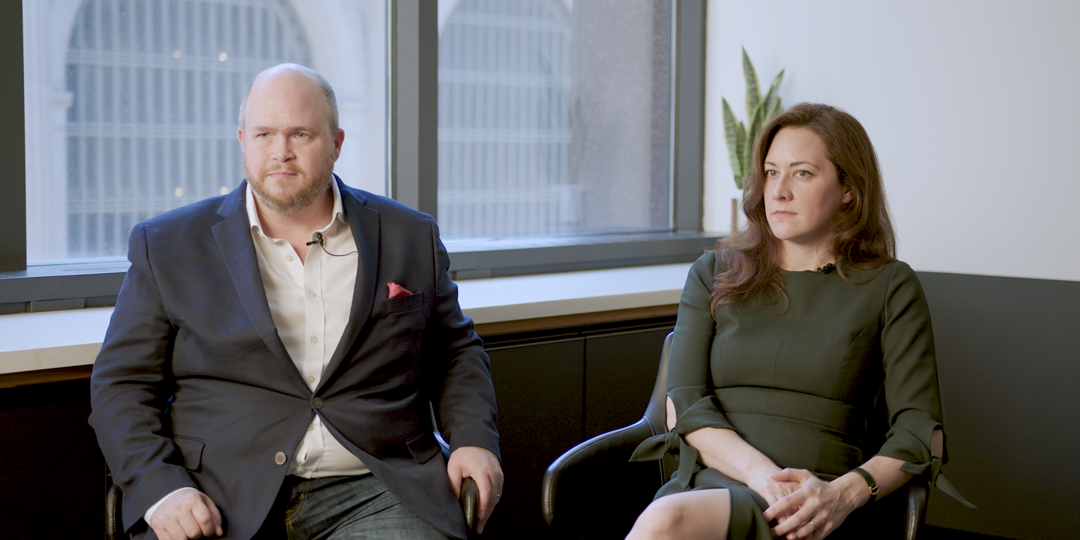
Maggie Sprenger and Peter Ackerson share insight into the implications of the current VC environment
Key Takeaways
- The Audere Capital co-founders highlight the expansion of the venture capital market globally, with a more diverse set of investors and strategies emerging, which should benefit the market in the long run, though - of course - not everyone will succeed.
- Recent market conditions have led to a reset in valuations, creating a renewed focus on fundamentals in venture capital. From a founder’s perspective, this creates greater rigor on capital efficiency, for investors it should create more longevity.
- Elevated inflation may help weed out all but the most determined and mission-driven founders, less-rigorous venture firms may struggle. Those that remain are likely to have a “moat” of competitive advantage that should support better long-term outcomes.
Transcript
I am Peter Ackerson, and I'm a general partner at Audere Capital.
Hi, I'm Maggie Springer. I'm a general partner at Audere Capital.
Audere Capital is an early-stage venture company focused on investing in five areas of critical technology that are on the cusp of what we think will be a significant multi-decade long run of impact. We invest into early-stage technology companies focused on the intersection of national security and priority, deep tech and easy, of course.
Historically, venture has been a very small and closed ecosystem or asset class and largely in deploying capital into a few geographies and into a few specific use cases. And that aperture is expanding widely. We're seeing a lot of different regions now beginning to embrace venture capital around the world. We're seeing a lot of different types of investors with different professional backgrounds coming into the market. And while many of them will prove to be tourists or not necessarily enjoy the experience or be effective within it, there will be, I think, in the future a lot more diverse investors, and there will be a lot more geographically diverse strategies in capital deployment, particularly post-COVID, and a much broader set of problems that are being solved through the deployment of venture capital into new company formation, all of which I think will be very beneficial for the market.
We've seen a significant reset in terms of valuations. And while I would say trying to time the market is a fool's errand, certainly, this makes it a very compelling time for entry. Now, the flip side of this, of course, is that there is less liquidity in the market overall. Interest rates are higher, inflation continues to be a major factor. That said, we're seeing a proliferation of really incredible companies and tied to valuations that are actually driven by fundamentals. This is almost a return to value investing. Venture is very highly correlated in the short term with interest rates and venture capital flows, which were really pronounced and really high levels of capital being raised and deployed over the last couple of years; that has completely changed. And one of the consequences is, of course, that money just becomes fundamentally more scarce in the market. And I think that includes across a number of asset classes, not just venture. And that's a short-term phenomenon, but one of the disciplines that that brings is that a lot of startups are coming into it grounded in much more fundamental valuation metrics. The pricing across the venture spectrum has reset, and that is, generally speaking, a good thing, both for founders and for investors, because from the founding perspective, it creates a lot more rigor on capital efficiency, and from the investing perspective, it creates a lot more longevity. Companies that are raising a realistic prices can then be valued, and you can have a more efficient market when it's not filled with sort of these frothy valuations.
For early-stage venture and certainly other asset classes, if inflation rates stay elevated, it's going to impact both on the allocator's side as well as on the founder and startup side. With regards to the founders and startups, what I think will happen is that we'll see only the best founders starting a company. These are going to be the people propelled either by an incredibly gritty attitude, and they just feel like they have to go do this or the ones who feel incredibly mission-driven because they have a solution that they feel the world has to have. On the allocators side, it's a tougher environment in which to raise money. And so I think this is going to lead to a couple of things. On the one hand, I think a lot of the tourist VCs that we've seen form firms and funds in the last few years are going to go out of business. This is going to further constrain capital available for founders. But what's nice is that for the firms that remain, it's going to be a moat of competitive advantage. It means that those firms will be able to participate in a bigger way in these outsized founders. And it means that for the years ahead, there's going to be a disproportionate advantage.
Venture is a ten-year asset class typically. And I think that's a good thing. You know, timing market cycles in general is not an effective strategy broadly described, but it's certainly not an effective strategy in venture. You really have to understand the markets and the technologies that you are investing into. And the earlier you go as an investor, whether it's mid-stage or seed stage, the more important the actual founders become and understanding the team and the determination. In many ways, I think of early-stage startups as kayaks. You know, they need to be prepared to weather a lot of different environments and rapids. So it doesn't really matter as much what the global macro title shifts are. One way or another, when every day you are in the waves trying to do early business formation and capture an opportunity. And so the expertise of whomever is in that seat or whichever team is in that role and the collection of investors and advisors that are surrounding them becomes critically important. And I think we're seeing all of that come together right now, which is, you know, is again, is a really fun thing to see in the market. I think it's a healthy thing. And I think if you look back at 2001, if you look back at 2008-2009, any time you come off of these sort of two or three-year peaks in valuation in an activity, there is a substantial number of companies that are fit for purpose and built for durability that end up becoming transformative over a longer period of time. And I would expect the same thing to happen here.
Important disclosures
Opto Investment Management, LLC (the “Firm”) is a wholly-owned subsidiary of Opto Investments, Inc. and is an SEC-registered investment advisor. Registration with the SEC does not imply a certain level of skill or training. SEC registration does not mean the SEC has approved of the services of the investment adviser. This website is operated and maintained by Opto Investments, Inc. Certain products described herein and institutional relationships may involve investment advisory services provided by the Firm. This website is presented for financial institutions and investment professionals only and is not intended for individual consumers or retail investors, unless specifically noted. Unless otherwise indicated, commentary on this site reflects the personal opinions, viewpoints and analyses of the author and should not be regarded as a description of services provided by the Firm or its affiliates. The opinions expressed here are for general informational purposes only and are not intended to provide specific advice or recommendations for any individual on any security or advisory service. It is only intended to provide education about the financial industry. The views reflected in the commentary are subject to change at any time without notice. While all information presented, including from external, linked or independent sources, is believed to be reliable, we make no representation or warranty as to accuracy or completeness. We reserve the right to change any part of these materials without notice and assume no obligation to provide updates. Nothing on this site constitutes investment advice, performance data or a recommendation that any particular security, portfolio of securities, transaction or investment strategy is suitable for any specific person. We disclaim any responsibility for information, services or products found on linked websites. Images and photographs are included for the sole purpose of visually enhancing the website. None of them show current or former clients and should not be construed as an endorsement or testimonial. All investing is subject to risk, including loss of principal. Historical performance is not a guarantee of future performance and clients may experience different results. This information contains certain “forward-looking statements,” which may be identified by the use of such words as “believe,” “expect,” “anticipate,” “should,” “planned,” “estimated,” “potential” and other similar terms. Examples of forward-looking statements include, but are not limited to, estimates with respect to financial condition, results of operations, and success or lack of success of the depicted investment strategy. All are subject to various factors, including, but not limited to general and local economic conditions, changing levels of competition within certain industries and markets, changes in interest rates, changes in legislation or regulation, and other economic, competitive, governmental, regulatory and technological factors affecting operations that could cause actual results to differ materially from projected results. See related disclosures at https://www.optoinvest.com/disclaimers.